The Capitol Hill Community Hall was constructed in 1947-1948 as a non-partisan public space to serve a variety of community groups, including groups with different political views and religious affiliations. The ability of the founding members to set their differences aside and work collaboratively to construct the hall for the benefit of the wider community is an enduring part of the hall's legacy.
The first meeting of the Capitol Hill Community Hall Association held in the building took place on December 16th, 1947, and final construction work completed in February 1948. An extension was added later in 1948, to extend the building to its current size.
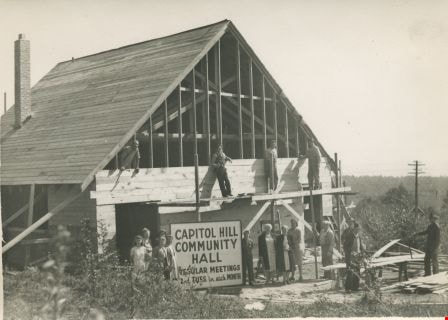 Capitol Hill Community Hall under construction, 1948. Copyright: City of Burnaby Archives 258-001
The Capitol Hill Community Hall is officially recognized as a heritage landmark by the City of Burnaby.
View Official Heritage DocumentationKey elements that define the heritage character of the Capitol Hill Community Hall include:
Located in Burnaby's Capitol Hill neighbourhood and adjacent to the terminus of the Hastings Street streetcar line at Hastings and Ellesmere Avenue
The building has social and community significance to the Capitol Hill neighbourhood, the City of Burnaby, and for local community organizations
Continuing use of the hall for community functions and events, such as meetings and gatherings, and civic functions as a polling station and as a venue for all-candidates meetings
Modest finishes and volunteer labour, to construct the building in a time of rising labour and building supply costs
Simple form, scale, and massing as expressed by its one-storey height, rectilinear plan, gabled roof. Consistent scale and design to neighbouring properties at time of construction
Located and built on a triangular shaped lot in a community park known as Dynes Park - named after William Dynes, an active member of the Hall Association and also the foreman of construction (the park was dedicated in 1944)
Architect: Harold Cullerne (1890-1976) designed the two-storey community hall in 1943. After returning from service during the First World War, he joined J.H. Bowman in a partnership that lasted from 1919 to 1934. After Bowman retired in 1934, Cullerne practiced on his own, continuing to work on schools and institutional buildings, such as the Art Deco Hollywood Theatre in Vancouver.
Construction: Wood-framed construction with large attic space. Built in two parts as seen by different construction detailing in the attic, ceiling panels, and foundation walls as per recorded minutes. The building was constructed through volunteer labour, including the work of William James Dynes who served as the project foreman, and George Green who served as the Chairman of the Building Committee.
Original brick chimney in first section of the hall to be constructed by Ernest Winch, M.P.
Today, the Capitol Hill Community Hall continues to serve as a vital gathering place for the community, maintaining its original purpose while adapting to modern needs. Every rental helps preserve this important piece of Burnaby's history.